About this site
One page, one job: put a named photographic look on a picture and let you decide how much of it you want. Everything else was left out on purpose.
The narrow brief
Most tools that offer filters offer everything at once — grades, patterns, frames, text, sharpening, exposure repair — and the result is a menu you have to navigate rather than a decision you get to make. This one covers colour mood and stops there. If a feature would change the structure of your photograph rather than its colour, it does not belong here and it has not been built here, however easy it would be to add once the engine exists.
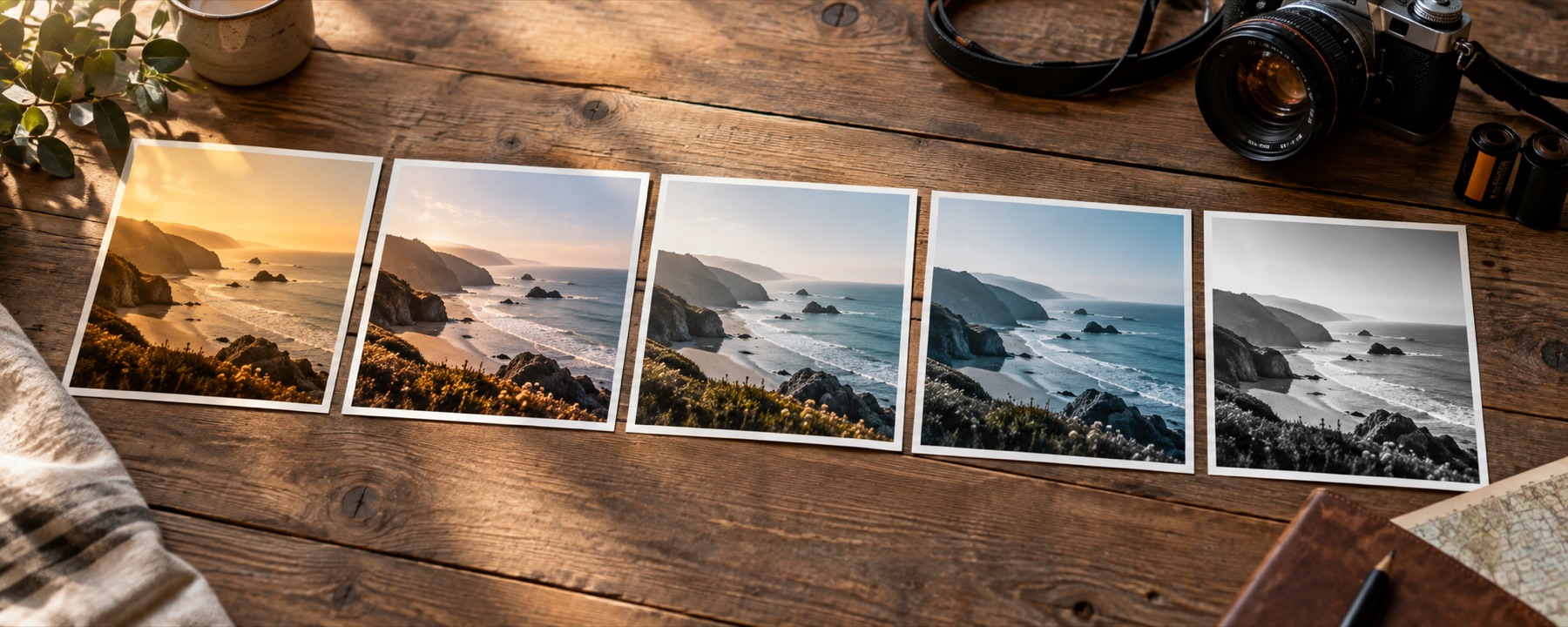
The narrowness is the point. A rail of eighteen thumbnails rendered from your own picture is only useful if every tile on it is the same kind of decision, so that comparing them means something. Mix in three effects that rebuild the picture and the rail becomes a menu again.
How a look is built
Nothing here was drawn by hand in an image editor and exported. Each of the twenty-four looks is a short recipe — some curves, a channel weighting, a colour pushed into the shadows, a lift under the black point — and that recipe is evaluated on your device into a table of about thirty-six thousand colours the first time the look is asked for. The table then goes to the graphics chip and every pixel in your photograph is one lookup into it.
That is why the site is small enough to load quickly, and why redrawing eighteen versions of a photograph is a modest thing to ask of a machine rather than an expensive one. Worth being exact about that: baking one table times at eight milliseconds, and the drawing afterwards is a single lookup per pixel, but no rail has yet been timed in a real browser, so read it as what the arithmetic costs rather than as a stopwatch reading. It is also why the looks can be described honestly: there is no secret sauce in any of them, only numbers, and the page tells you which numbers do what.
Three rules it was written to
Nothing is uploaded. Graded on your device. The file never goes anywhere. There is no server behind this page to send anything to, which is a structural fact rather than a policy — the whole site is static files and a shader.
The tool comes first. The rail and the preview own the top of the page. Reading material sits underneath, leaving the working surface uninterrupted and visually separate from the explanation below it.
Limits get said out loud. Every page here that explains something also says where the thing stops working. A look cannot recover blown highlights, cannot turn a phone into a cinema camera, and cannot treat one part of a picture differently from another. Saying so is more useful than a longer feature list.
Who made it
It is one of a family of small single-purpose picture tools, each doing one thing and pointing at its neighbours only where a reader genuinely needs one. The family is credited here in plain text without a link. If something here is wrong — a look that misbehaves on a particular file, a claim on a page that does not hold up — it is worth knowing about, because most of these pages are arguments and an argument with a hole in it should be fixed rather than left.
The privacy page explains exactly what this site can and cannot see, and the terms are short.